The Good, The Bad, and The Ugly of LMS Training in Multifamily
Let's have an honest conversation about the tool everyone's using and almost nobody's auditing.
The Learning Management System was supposed to solve everything.
Standardized training. Scalable delivery. Compliance documentation with a few clicks. No more expensive trainers flying in for a day, no more "she said she trained them" with no paper trail.
And look — some of that promise delivered. For compliance-driven training, Fair Housing certification, and onboarding documentation, an LMS is a legitimate tool. Anyone who tells you otherwise is selling something.
But somewhere along the way, "we have an LMS" became shorthand for "we have a training program."
It's not the same thing. And in leasing operations, that gap is costing operators real money.
The Good: What LMS Actually Does Well
Compliance and documentation. This is the LMS's strongest lane, and it's genuinely important. Fair Housing laws, sexual harassment training, safety protocols — the legal exposure from undocumented training is real, and an LMS solves for it cleanly. When a discrimination complaint arrives, the ability to pull timestamped completion records is worth every dollar of the subscription.
Consistency at scale. For a company managing 20+ properties across multiple states, it's impossible to guarantee uniform training through in-person sessions. An LMS ensures every leasing agent in every market sees the same content. That matters for brand standards, legal protection, and baseline knowledge.
Accessibility. The multifamily workforce is mobile-heavy and schedule-driven. Leasing agents aren't sitting at desks waiting for training windows. A well-built LMS lets people train between tours, during slow morning hours, from their phones. That flexibility is real and genuinely valuable.
Onboarding structure. New hire onboarding without an LMS is often a mess — whoever happens to be available trains the new person in whatever way they learned it. An LMS creates a structured path that gets people to baseline competency faster. Grace Hill data shows the cost of replacing a leasing employee runs nearly $5,000 per hire, and faster onboarding directly compresses that cost window.
The Bad: Where LMS Falls Short
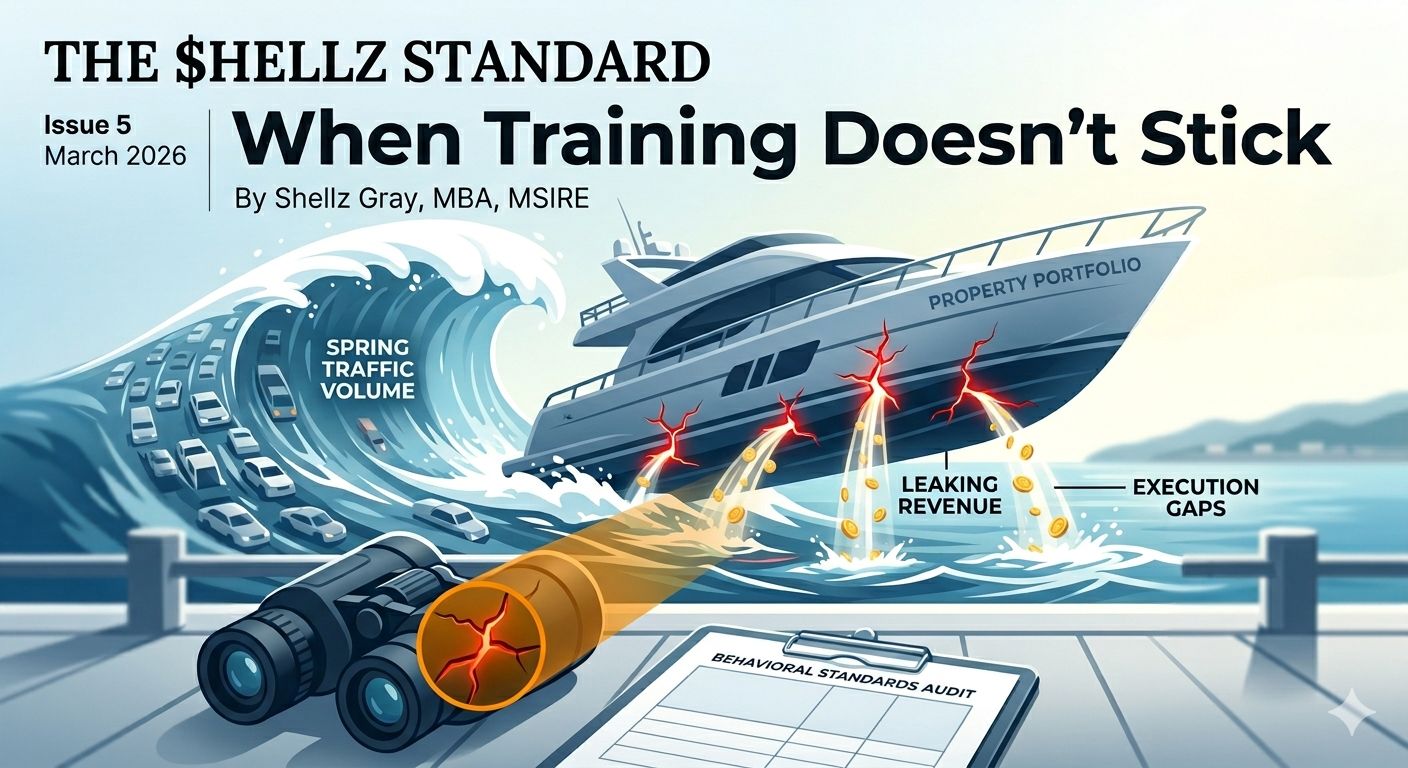
Completion is not comprehension. This is the dirty secret of every LMS dashboard. A 95% completion rate looks excellent in a report. It tells you almost nothing about whether behavior changed. Leasing agents have become experts at clicking through modules efficiently — answering questions by process of elimination, skipping video segments where the system allows it, completing required courses the day before they're due.
The measurement of success is a checkbox, not a conversation.
The forgetting curve doesn't care about your subscription cost. Research going back to German psychologist Hermann Ebbinghaus confirms what anyone who's ever sat through a mandatory training knows intuitively: without reinforcement, people forget up to 90% of what they "learned" within a week. An LMS module assigned once, completed once, and never referenced again is not training. It's documentation with extra steps.
Passive learning has a ceiling. Studies on active vs. passive learning show that hands-on learners retained 93.5% of information after one month, compared to 79% for passive learners. An LMS module — even a well-designed one — is inherently passive. Watch, click, submit. That model can build knowledge. It cannot build habits.
And in leasing, habits are the whole game.
It creates an illusion of accountability. Here's the organizational danger nobody talks about: when a property underperforms, the LMS gives leadership a way to say "we trained them" without asking harder questions. Completion rates become a shield. The real questions — Are tours converting? Are follow-up calls happening? Are objections being handled? — stay unasked because the training box is checked.
Online LMS course completion rates can be staggeringly low. Some online learning environments report completion rates as low as 12%. Even well-managed programs often struggle with engagement, which is why platforms like Grace Hill and Edge2Learn have had to build gamification, leaderboards, and incentive systems just to get people to finish what they've been assigned.
That's not an indictment of the platforms — it's an honest description of the challenge.
The Ugly: What Nobody's Saying in the RFP
An LMS trains knowledge. Leasing requires behavior.
This distinction matters more than most operators realize. Knowing that a 24-hour follow-up is best practice is different from actually making that call consistently, even when the day got busy, even when the lead feels cold, even when the manager didn't ask about it.
Knowledge lives in the head. Behavior lives in the habit.
The properties with the strongest leasing performance are not necessarily the ones with the most sophisticated LMS. They're the ones where managers reinforce behavior daily — where the follow-up call is checked, where tour conversion is discussed, where a missed confirmation call gets a conversation, not just a module assignment.
Most LMS platforms were designed to serve compliance, not conversion. The multifamily LMS market — dominated by platforms like Grace Hill, Edge2Learn, and RealPage's EasyLMS — grew out of a compliance need. Fair Housing. Safety. Policy acknowledgment. These are legitimate and important. But they are not the same as revenue performance training.
When an operator uses their compliance LMS as their leasing performance tool, they're using a hammer where they need a scalpel.
The small operator problem. For operators running 200–500 units across a handful of properties, a full LMS subscription may cost more than it delivers. The compliance use case is real, but the ongoing leasing development use case often isn't being served — not because the platform can't do it, but because no one is managing it actively enough to make it work.
The LMS becomes a line item that looks like investment but functions like insurance.
So What Does Good Actually Look Like?
I'm not anti-LMS. I'm pro-honest evaluation.
The operators getting the most out of their training investment are combining tools intentionally. They're using their LMS for what it does best — compliance documentation, baseline onboarding, standardized policy training — while layering behavioral reinforcement on top of it through manager coaching, consistent accountability routines, and real performance tracking tied to actual leasing outcomes.
The question worth asking is not "do we have an LMS?"
The question is: "Is our team's behavior in a leasing conversation actually different because of how we're training them?"
If you can't answer that with data — tour conversion rates, response time metrics, follow-up consistency — then you have training activity, not a training system.
The Bottom Line
The LMS is a tool. Like any tool, it performs exactly as well as the operator managing it.
Used well: it standardizes compliance, protects the organization legally, and creates a foundation for onboarding.
Used as a substitute for real performance development: it creates the illusion of a training culture while the same behavioral gaps that cost you leases last year cost you leases again this year.
The industry deserves an honest conversation about the difference.
Ready to audit what your training is actually producing — not just what it's completing? That's exactly what Revenue Guard OS was built to diagnose.
Training that gets practiced, not presented. Shellz Training Guard™ — onsite leasing training for multifamily teams. apartmentleasingtraining.com