
Your Tours Went Fine.
Your Tours Went Fine. Did Anyone Ask for the Application?
September, 2026
We spent the season measuring what actually happens on leasing floors. We found 77 things that didn't.
I spent this leasing season inside our clients' offices. On the phones. On the tours. In the follow-up. Not reviewing reports about the floor — on the floor.
We measured against a 190-point behavioral standard — what good looks like at every step of the leasing path, from the first phone call to the follow-up nobody makes.
Seventy-seven of those standards came back unearned. Different properties, different markets, different teams.
Different markets, same misses. When the same behaviors fail in Ohio and fail again two states away, it isn't a team problem. It's something nobody built into the process in the first place.
Where the misses actually live
The 77 sort into the nine stages of the leasing path.
First contact, 13. Arrival, 5. Discovery, 6. The tour, 7. Value, objections and urgency, 15. Money and policy, 8. The close, 9. Follow-up, 8. The system, 6.
Fifteen in value and urgency. Nine more at the close. Twenty-four of seventy-seven concentrated in the back half of the tour.
The front half mostly held, and some of that isn't people anymore. AI captured the leads. AI set the appointments. Phones got answered, prospects got greeted, tours happened, and by every account they went fine.
But look at first contact — thirteen misses, the second-biggest bucket on the list, in the stage everybody assumes is solved.
The appointment got booked. Nobody confirmed it. No call the day before, no text that morning, nothing to find out whether this person was actually coming. The tool did exactly what it was bought to do and then handed off to nobody.
So the appointment sits in the CRM looking like a win, and the prospect never walks in.
Then the last twenty minutes
For the prospects who did show up, the tour went well right up until it ended.
Nothing in the close gave anyone a reason to sign. No reasons-to-act. No trial close. No ask. She said she'd think about it, the agent said take your time, and a tour that went fine became nothing.
That is what a season of "we were busy, it just didn't convert" is made of. These were gaps in what happens on the floor, they were consistent across markets, and they cost these properties leases and rent.
The part your dashboard can't see
Your CRM knows a tour happened. It does not know what happened inside it.
That's the blind spot in one sentence. Arrival, the tour, value and urgency — twenty-seven of the seventy-seven — all live in the space between the appointment and the outcome, and there's no field for any of it.
Which explains a conversation a lot of regionals and owners had in August.
The property says the season was solid. Traffic was there. Occupancy held. And the trailing numbers don't agree. Nobody is lying to you — the property is reporting what it can see.
The number that does leak through is tour-to-application, because both ends of it get logged even though the middle doesn't. If it's soft while traffic looks healthy, the back half of the tour is where to look. And if nobody at the property can tell you that number off the top of their head, you've learned something already.
Why more content doesn't close it
I've been on the other side of this. I built L&D programs. I ran YieldStar training at RealPage. I've spent a good part of my career being the person who bought the course, launched the platform, and tracked the completions.
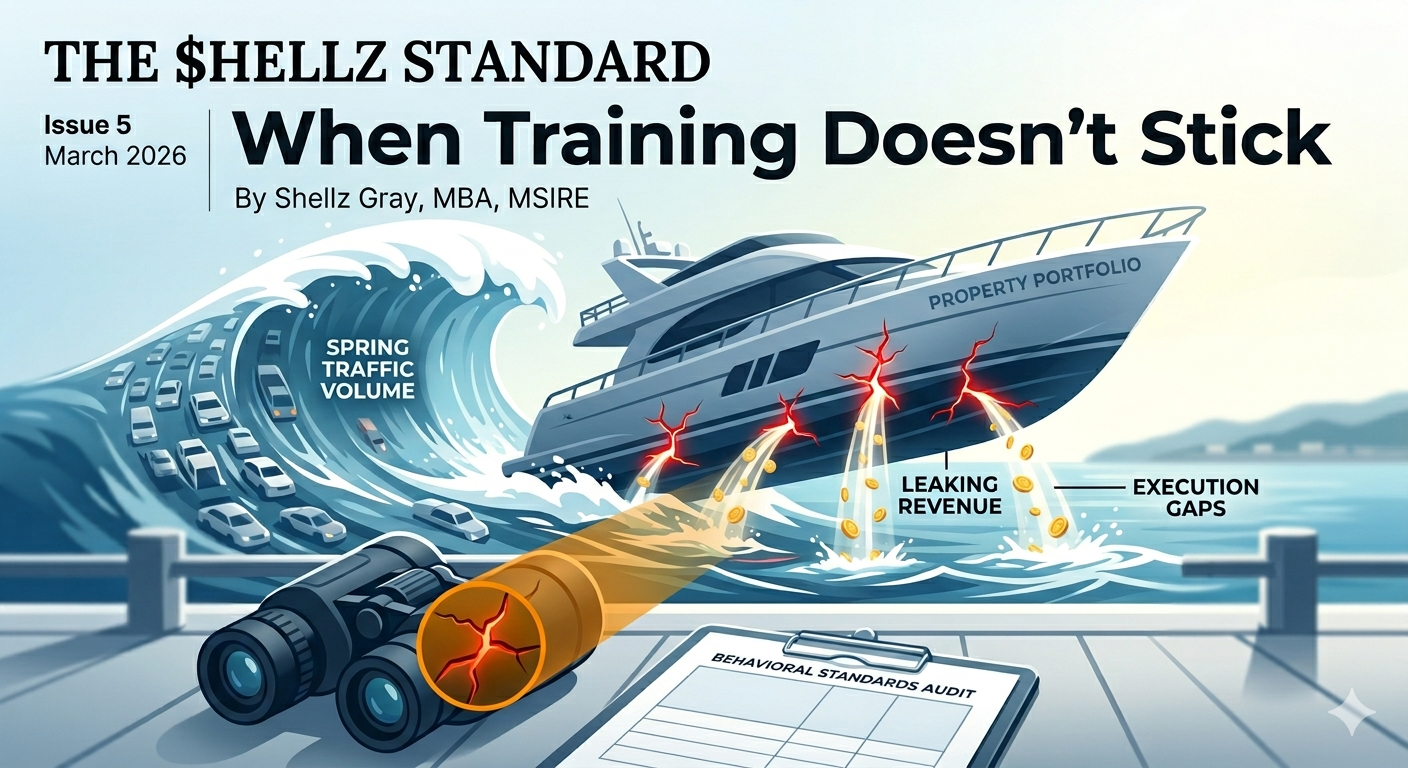
Content teaches the process, and it does that well. What it cannot do is hear how somebody handles the price objection at 4:45 on a Friday. It can't tell whether the ask happened. It reports that a module was completed — a fact about a video, not a fact about your leasing floor.
Trained is not changed. That's not a knock on your platform or your people. It's the gap between knowing what should happen and making sure it actually happens.
Run this yourself this week
Fifteen minutes, no cost, and it will tell you which of the nine stages you're standing in.
Ask five agents at your weakest-converting property: what are the five reasons someone should sign here this week?
Five different answers is the miss. A pause finds it faster. Most properties have never written that list down, which means every agent improvises urgency at the end of every tour — and improvised urgency sounds like pressure, which is exactly why agents avoid doing it at all.
Then pull two numbers for that same property: how many appointments were set, and how many people walked through the door. Put all of it next to each other.
What we do about it
Shellz Training Guard is a day in the building with your team, and I run it.
We take the stages where your own numbers are soft and work the exact moments on this list — not concepts, the moments. Who confirms the appointment and when. The team builds their own reasons-to-act inventory for their own property, in their own words, then runs it against live objections until agreeing with the objection stops being the reflex. The ask gets repped until it stops sounding like a question.
Every manager leaves with a written play: the standard, what to watch for, how to coach the miss, how often to check.
Then I come back at thirty days and we look at whether it held.
That last part is the whole thing. Practice, and then a check. Anything that walks out of the building with the trainer was a presentation.
This past season, closing these gaps is the work we did. We can do the same for you.
Why September is the window
Peak demand has passed. What's left is a smaller pool of prospects and everything you're still carrying.
That math cuts one way. When traffic was heavy, average execution still filled units — volume covered the misses. It doesn't now. Every remaining prospect has to convert at a higher rate than the ones who came through in June, and there are fewer of them to get it wrong with.
And exposure in September isn't a September problem. What your team doesn't close in the next few months carries into spring. You know what that costs on your own rent roll better than I do.
Which is also why nobody trains in July. You can't pull a team off the floor at peak, and I wouldn't ask you to.
You can now. There's still enough year left to close what can still be closed for 2026 — and to walk into Q4 reporting with a different number than the one you're looking at today.
The full series is up — 77 Misses, eleven episodes across the nine stages.
Strong leasing is practiced, not presented.
— Shelly
About the author
Shelly Gray, MBA, MSIRE is the founder and CEO of Shellz Property Partners. After 28 years in multifamily — leasing floors, RealPage revenue management, and L&D leadership — she built Shellz Revenue Guard OS on one belief: you can't fix what you haven't properly found.
Shelly Gray · Founder & CEO, Shellz Property Partners · sgray@shellzpropertypartners.com