When Training Doesn't Stick
Human intelligence still needs to lead the leasing floor.
Spring traffic is here, which means most operators are about to find out whether their off-season training investment actually worked — or whether the volume is just making it impossible to tell.
This is the question worth sitting with right now — before the volume hides everything again.
You trained your team during the off-season. Did it stick?
The Lift That Lies
Most teams see a short burst after training. Energy goes up. Managers feel optimistic. A few metrics move.
Then six weeks pass.
The order takers come back. The hesitation on price returns. The follow-ups get hollow. The closing ask disappears again. Not because your team is bad — because awareness is not a habit, and training built on information was never designed to change behavior.
That is not a people failure. That is a design failure. And in an industry with constant staffing churn, building habits that survive new hires is the only sustainable advantage. If the behavior lives only in the training event and not in the daily environment, it walks out the door with every departing team member.
Rule This Out First
Before you invest another dollar in training your people, make sure your systems are not working against them.
Broken lead routing, no mobile CRM access, mandatory guest cards that force feature-dumping before discovery, AI self-scheduling with zero human follow-up — these create behavioral failures that no amount of motivation or skill-building can overcome.
If your systems are creating friction at the exact moments your team needs to perform, fix that first. Otherwise training will keep failing and you will keep blaming the team.
What Traditional Training Was Actually Built to Do
Let's be clear about something the industry rarely says out loud: traditional training is not the enemy.
LMS modules are excellent for compliance, consistency, and knowledge transfer. Workshops and motivational sessions can reinforce culture, reignite energy, and remind a team why the work matters. These tools have real value.
The problem is not the tool. The problem is the sequence.
When operators lead with motivation before behavior is fixed, they are building on an unstable foundation. The energy lifts. The habits underneath do not move. And six weeks later the team is right back where they started — except now the budget is spent and leadership is frustrated.
Install the core behaviors first through deliberate daily practice. Only then layer on the motivational sessions and knowledge reinforcement. The foundation must be stable before the energy can stick.
The operators getting the best return on their training investment are the ones who follow that sequence. It is not complicated. It is just rarely followed.
The Real Gap No One Is Measuring
Here is what traditional training cannot tell you: what is your team actually doing in the moments that determine whether a lease closes or walks?
These are the moments that matter — and they happen dozens of times a day on every property in your portfolio:
A prospect pushes back on price. Instead of reframing value and staying in the conversation, your agent hesitates, deflects, or reaches for a concession.
The tour starts and your agent jumps straight into amenities and floor plans without first asking what actually matters to that prospect. They pitch. They don't discover.
The tour ends and the closing ask doesn't happen. No specific unit. No move-in date. No direct question. The prospect leaves with brochures and good feelings and no commitment.
The follow-up goes out — a template, a generic "just checking in," something that could have been sent to anyone. The prospect who needed a real conversation gets a mail merge.
A self-scheduled tour is on the books and nobody makes the human confirmation call. The appointment ghosts. The lead is marked as lost. The behavior that caused it is never corrected.
These are not knowledge failures. Your team knows what they should do. This is an execution gap — the distance between knowing and doing it consistently under pressure. High spring volume does not close that gap. It hides it.
Why Daily Repetition Changes What Quarterly Events Cannot
Real behavior change in leasing happens through short, focused daily practice — ten to fifteen minutes of deliberate work on one specific moment, the objection, the close, the discovery question, repeated consistently until it becomes instinct under pressure.
Quarterly workshops cannot build that. A motivated team on a Monday cannot hold that standard by Friday without a structure that reinforces it daily.
The operators who see lasting improvement are not the ones who train the hardest twice a year. They are the ones who made the right behavior the easiest behavior to repeat every single day.
The Manager Accountability Layer
The biggest reason trained behaviors don't stick is that managers are rarely equipped to maintain them between sessions.
Most managers are asked to coach without tools, observe without a standard, and give feedback without a framework. So they default to encouragement — which feels like support and functions like nothing.
Give your managers simple, repeatable structure: observe one specific behavior per week, give immediate feedback tied to that behavior, and hold the standard in real time. Without this layer, even the best off-season training fades by week six. The manager is not the problem. The absence of structure around them is.
The Internal Trainer Question
Many internal trainers are asked to play the wrong role: delivering energy and information instead of guarding execution. That is not a reflection on the person. It is a reflection on how the role was defined.
If your internal trainer's primary measure of success is how the team feels after the session, you have not hired a performance solution. You have hired a motivational resource — and that resource has real value, but only after the behavioral foundation is in place.
Redefine the role around revenue guarding: identifying where the process breaks down under pressure, correcting it before it becomes a pattern, and measuring execution weeks after the session — not feelings the day of. An internal trainer deployed on a stable behavioral foundation is one of the most powerful investments a portfolio can make. Deployed before that foundation exists, their best work has nothing to land on.
What Usually Goes Wrong
Even operators who understand the right sequence fall into the same traps:
Rushing the behavioral phase because traffic is high and there is no time to slow down and drill. Letting managers skip real-time coaching because the phones are ringing. Measuring how the team felt after the session instead of what they are actually executing three weeks later. Abandoning the new habits the moment spring volume picks up because the numbers look fine. Confusing a temporary lift from traffic with proof that the behaviors actually changed.
The Question Worth Asking Before June
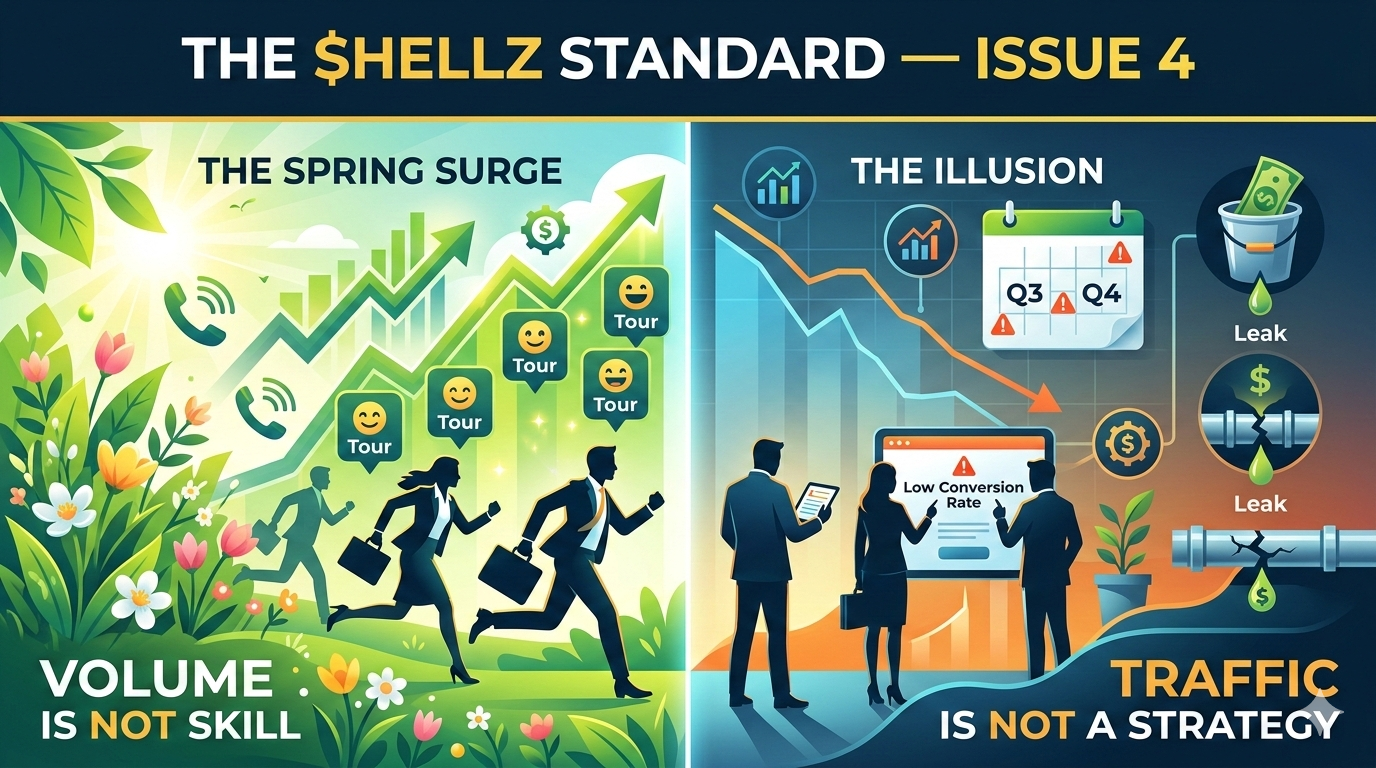
Spring will make your numbers look better. It will not make your habits better.
Before June hits and traffic masks everything again, ask yourself: are you actually fixing the behaviors — and the system that shapes them — or are you simply training harder on an unstable foundation?
Offering your team motivation without first installing stable daily behaviors and a supporting system is not a training strategy. It is a disservice. They deserve a foundation that makes the lift last — one built on daily standards, manager accountability, and a system that makes the right behavior repeatable no matter who is on the floor or what the market is doing.
The operators who protect revenue through every season are the ones who stopped confusing training events with performance standards. They treat behavior as a system, not an event. That is the Shellz Standard.
The Shellz Standard is written for operators who are willing to ask the harder questions.
About the Author
Shelly Gray, MBA, MSIRE is the founder and CEO of Shellz Property Partners. She trains and staffs multifamily leasing teams — but unlike traditional training companies, she diagnoses first. After 25+ years in the industry, she built Revenue Guard OS™ around one belief: you can't fix what you haven't properly identified. Her work helps operators stop losing revenue to the leasing behaviors their dashboards never show them.