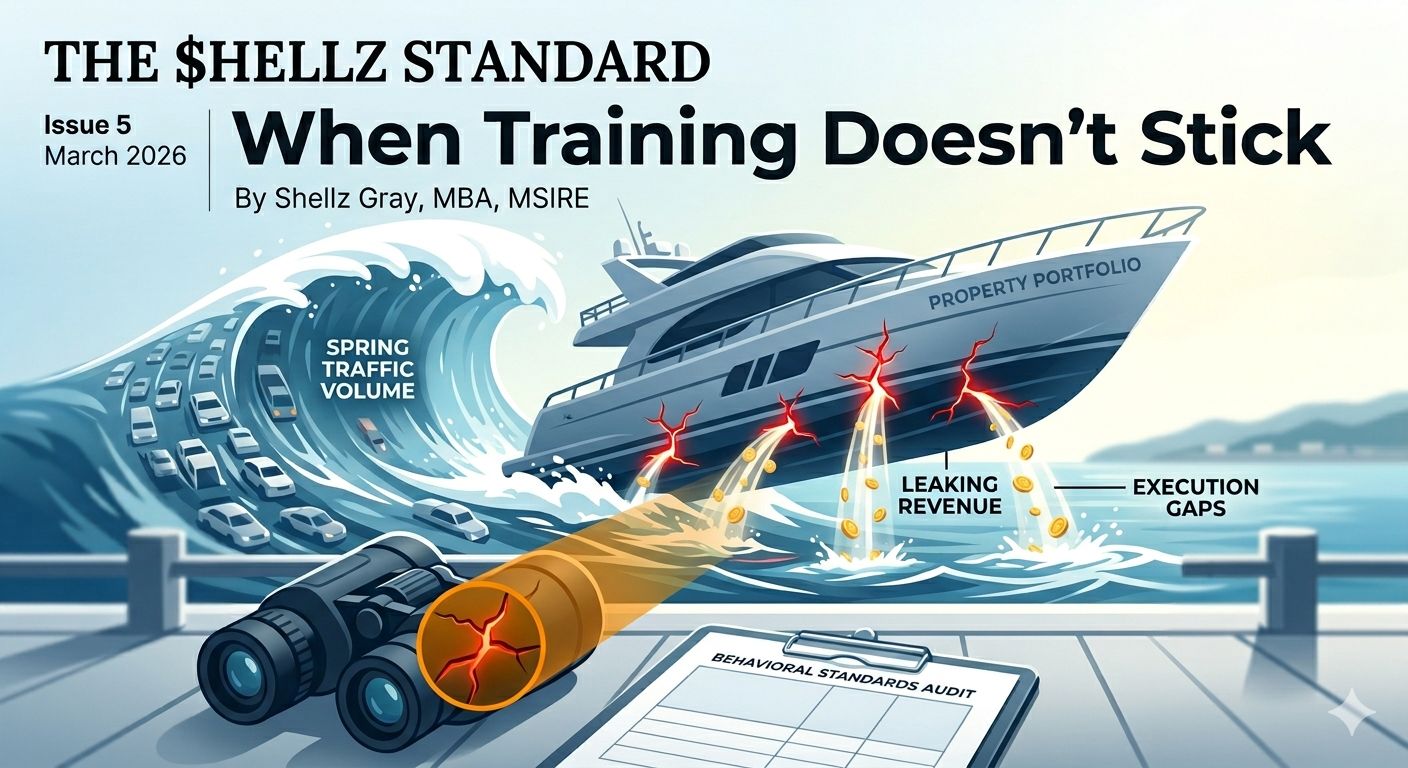

You Bought the AI, Are Your Leases Still Slipping?
Why automation changed your workflow but may not have changed your results.
That dashboard looks good, doesn't it. Response times down. Lead volume up. Everything green. And yet — for many operators — lease conversion still didn't move the way they expected.
Did we do our part? That's the question most teams haven't asked yet.
The Expectation Gap
Most teams bought AI with one belief driving the decision: it will fix leasing performance.
That belief was incomplete.
AI can surface leads faster than any human team. It can respond at 2am, follow up without being reminded, and schedule tours without a single phone call. What it cannot do is make a leasing consultant curious, confident, or disciplined.
The expectation became automation. The real problem was execution.
Those are two different problems — and only one of them has a technology solution.
Ten Patterns Operators Rarely Question — But Absolutely Should
Before asking whether the AI worked, ask whether any of these sound familiar.
1. The assumption that AI solved follow-up. Most teams never checked whether follow-up quality improved — only that the task was completed. That gap alone can tank conversions.
2. The belief that faster responses equal better responses. AI shaved minutes off reply time. But the replies themselves are still generic, reactive, and disconnected from what the prospect actually said.
3. No human standard to measure AI against. Teams adopted AI without defining what a good human conversation looks like. If you don't know what good is, you can't tell whether AI is helping or masking weak habits.
4. The quiet drop in human urgency. When AI handles reminders and follow-up nudges, leasing teams often stop initiating on their own. They assume the system sent something. They stop checking whether it worked. The lead goes cold and nobody owns it.
5. Operators reading summaries instead of actual conversations. AI summaries hide tone, confidence, hesitation, and missed openings. The summary says the follow-up was sent. It doesn't tell you it landed flat.
6. Celebrating dashboard metrics while outcomes tell a different story. Response time: green. Task completion: green. Occupancy: slipping. The behaviors that actually convert leases don't always show up in the report.
7. The tour experience nobody touched. AI improved the front end. The in-person tour still follows the same script, with the same weak transitions and the same missed emotional hooks.
8. "We trained them once" as a strategy. AI tools evolve weekly. Human habits don't. When the workflow changed — more automation, fewer direct touchpoints, new handoff moments — most teams never recalibrated how their leasing consultants were expected to show up inside that new process.
9. Nobody coaching confidence in pricing conversations. AI cannot coach a leasing consultant through the moment a prospect flinches at the rent. If your team still crumbles when the number lands, no automation recovers that lease.
10. Insights with no owner. AI produced the data. Nobody turned it into a Monday morning behavior change. Without that bridge, the insight expires and the pattern repeats.
The Data Comfort Trap
Technology does one thing exceptionally well: it produces beautiful dashboards.
Response times. Lead volume. Sentiment scores. Marketing attribution. All of it visible, trackable, reportable.
Here is what most dashboards cannot show you: a leasing consultant who stops listening the moment a prospect mentions they're also touring somewhere else. A follow-up email sent on time but written so generically the prospect didn't bother responding. A tour that generated excitement but never asked for the decision.
The behaviors that convert leases are largely invisible to technology. Managing by dashboard alone means the most important part of the picture isn't visible yet.
The Five Human Moments AI Cannot Solve
Five moments still determine whether a prospect becomes a resident. They are entirely human. And they are happening — well or poorly — on your properties right now.
1. The Discovery Conversation What should happen: A consultant who asks real questions, listens for what matters, and connects the home to the person's actual life. What often happens instead: A checklist. Bedrooms, price, move-in date. Next.
2. The Tour Experience What should happen: A guided experience that builds emotional connection and moves toward a decision. What often happens instead: A walk-through with a key and a hope.
3. Handling the Price Objection What should happen: A confident, value-based response that reframes the investment. What often happens instead: A concession offered before the prospect even pushed back.
4. Creating Urgency What should happen: A genuine, property-specific reason to decide today. What often happens instead: Silence — or a scripted line so familiar the prospect has already tuned it out.
5. Follow-Up That Feels Personal What should happen: A message that references the specific conversation, the specific need, the specific home. What often happens instead: An automated message sent into silence, checked off a list.
A Moment Worth Sitting With
If you read through those five moments and found yourself thinking about a specific property, a specific team, or a specific conversation that didn't go the way it should have — that reaction is worth paying attention to.
The Real Question
The industry spent two years asking: Did the AI work?
That was the wrong question.
The right one is: Did we redesign how our leasing teams operate once AI entered the system?
Technology changes the workflow. Only leadership changes the expectations around it.
AI can accelerate the leasing process. It cannot replace the behaviors that close the lease.
About the Author
Shelly Gray is the founder and CEO of Shellz Property Partners. She trains and staffs multifamily leasing teams — but unlike traditional training companies, she diagnoses first. After 25+ years in the industry, she built Revenue Guard OS™ around one belief: you can't fix what you haven't properly identified. Her work helps operators stop losing revenue to the leasing behaviors their dashboards never show them.
Shelly Gray, MBA, MSIRE Founder, Shellz Property Partners
The Shellz Standard is written for operators who are willing to ask the harder questions.